
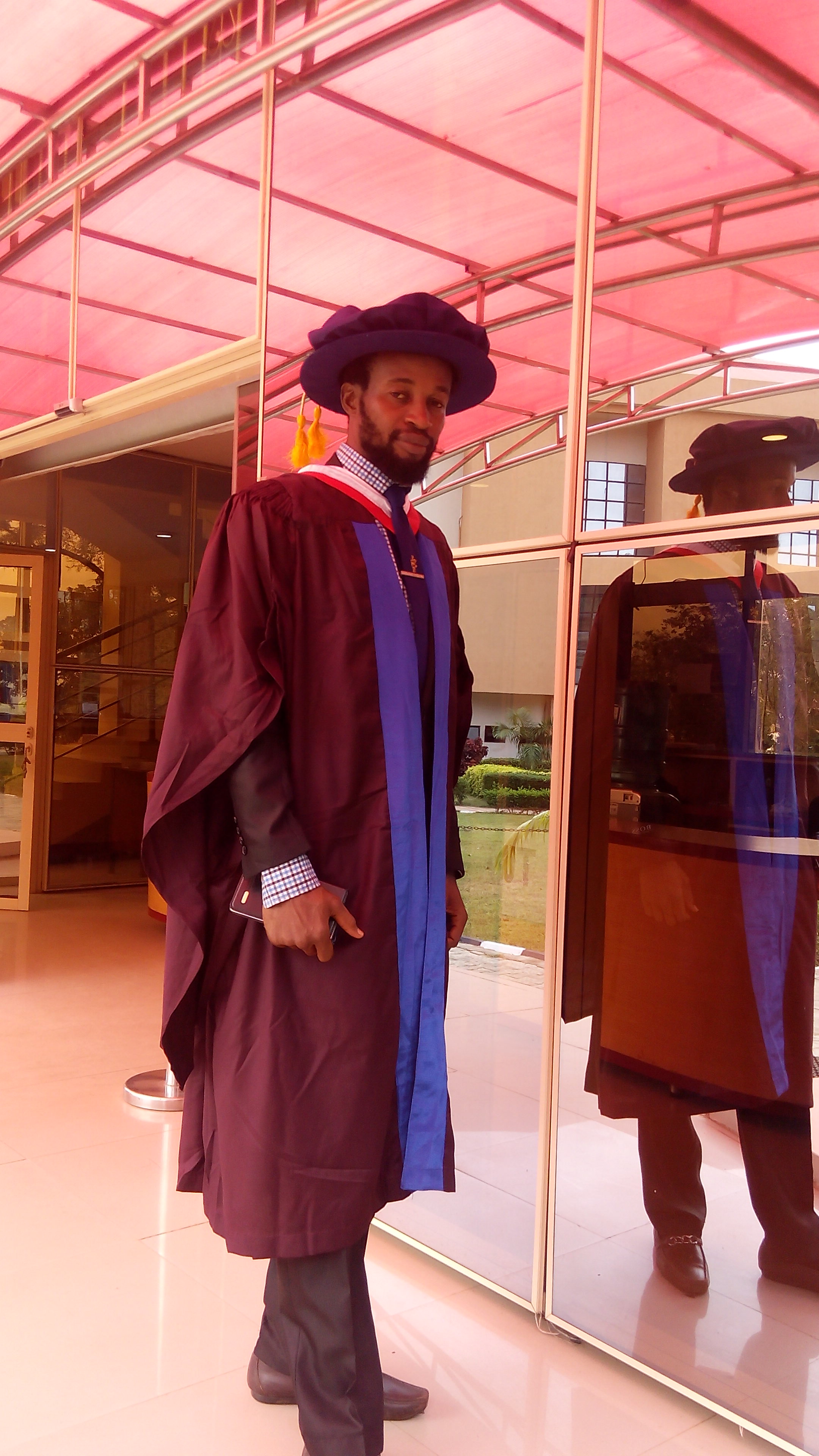
ABANIKANNDA Mutahir O.
Associate Professor
COLLEGE OF EDUCATION
SCI. TECH & MATHS EDUC.
Brief Educational Profile
Mukhtar Oluwafemi ABANIKANNDA (Ph.D.) is an Associate Professor of Computing/IT Education. He is a digital innovation specialist who is into Digital Transformation, Learning Technologies, Technopreneurship, Artificial Intelligence, Cybernetics, Science & Technology Education. He holds degrees of prestigious universities in Science, Science Education and Technology Education. Aside other numerous commendable contributions to knowledge, he wrote the first postgraduate degree thesis in Nigeria on the application of hypermedia courseware to science learning, designed and produced the first hypermedia instructional strategy for learning Chemistry in Nigerian Schools. It is worth noting that he was the first anywhere in the world to employ Kirkpatrick's evaluation model to assess computer-based concept mapping strategies which he designed and developed in the field of Chemistry, this includes the fact that he designed, developed and produced his own distinct models for the assessment of computer-based learning strategies.
Dr. Abanikannda has been deeply involved in carrying out funded and non-funded research projects nationally and internationally both as a Principal Investigator and as a Co-Investigator in worthy research grants on: Digital Learning Technologies, Hybrid Learning, Artificial Intelligence, Digital Perspectives of Cultural Diversity and Development of Artificial Neural Network-Based Model for Estimating Nano Pollution among others. Generally, he has ventured into: AI, Fuzzy Logic and Neural Networks, Potentiality of Web Syndication and Offline Media Streaming Portmanteau in Procedural Knowledge Optimation, Podcast Potentiality in Increasing Students’ Self-Steams and Performance Transformations and Creating a Secure and Flexible Path to Public Cloud through Digital Learning Transformation. He has dabbled into the implications of using big data and artificial intelligence for research management, Human-Computer Interaction, Augmented Reality, Engineering Education and Transformational Learning. Dr. Mukhtar Oluwafemi ABANIKANNDA has won a number of travel grants to his credit.
Abanikannda has also been deeply involved in series of advancements in the frontiers of knowledge as regards digital innovation and engagement. This has provided opportunity for creative engagement in solving global and contextual problems and created access for Africans to participate in the burgeoning economy of the technology space. Consequently, he facilitated a Digital Innovation and Business Start-up Hub (DIBUSH) in Osun State University with a mission to support the aforementioned by providing opportunities for trainees and innovators within his immediate environment. He is the Implementation Facilitator and Head of DIBUSH, he is a member of the Supervisory board of Opolo Global Innovation Limited (Opolo Global Innovation Limited, is a leading innovation enabler, incubator and accelerator closely connected with Fintech). Mukhtar is a consultant to some popular agencies and an external assessor to a number of tertiary institutions and research institutes. He has published more than Ninety articles in reputable journals and contributed many chapters to quality books. He has attended seventy-five national and international conferences till date. He belongs to numerous professional national and international bodies including: WAOE,IFETS,MERLOT,AITIE,EMTAN,TRCN,NAE,ISOC,ACS,RSC,CSN, CCON,AARF,IAARR,IAAM,ECTRD,Tech Republic. He has been Sub-Dean Pg. & Sub-Dean of Students. He was a two-term Branch Chairperson of the Academic Staff Union of Universities and a two-term internal member of the Governing Council of Osun State University. He is currently the Director of Academic Planning in the Office of the Vice Chancellor (President) and the National Public Relations Officer (P.R.O.) of the Committee of Directors of Academic Planning of Nigerian Universities (CODAPNU).
Academic Profiles
ORCID
Google Scholar
https://scholar.google.com/citations?hl=en&user=NhmOdCQAAAAJ
ResearchGate
 OpenAlex
Current/Recent Research
Dr. Abanikannda has carried out funded research projects both as a Principal Investigator and as a Co-investigator. A few of the numerous grants won from TETFUND IBR, TETFUND-NRF, UNESCO-IFCD, and executed, include those on Digital Learning Technologies, Hybrid Learning, Artificial Intelligence, Digital Perspectives on Cultural Diversity, and the Development of an Artificial Neural Network-Based Model for Estimating Nano Pollution. He was a two-time recipient of the Tertiary Education Trust Fund NRF Grant, who also won the TETFund grant for Institution-Based Research twice and has participated in three international grants and won three travel grants to his credit.
Selected Recent Publications
- •Adeniyi, I. A. and Abanikannda, M. O. (2026). Urbanization-ICT Nexus and Environmental Sustainability in West African Countries: A Cross-Sectional ARDL Approach, 7 (3): Special Issue. Journal of Development and Society, Faculty of Social Sciences, University of Abuja. https://uniabujafsos.com.ng/index.php/jdsfoss/article/view/54
- •Ogen, O., Abanikannda, M. O., Lawal, N. (2025). Digitization and the recreation of Yorùbá cultural moral tales. Digital Scholarship in the Humanities. 40 (3), 863–870. Published by Oxford University Press https://doi.org/10.1093/llc/fqaf054
- •Zakariya YF, Berg MT, Gjesteland T, Umahaba RE and Abanikannda MO (2025) From single to multiple assessments in a foundational mathematics course for engineering students: what do we gain?. Front. Educ. 10:1544647. doi: 10.3389/feduc.2025.1544647
- •Thomas, G., Gambari, A. I., Yusuf, H.T., Abanikannda, M. O., Daramola, F. O. (2024). Assessment of lecturers' awareness of artificial intelligence for education in a Nigerian university. Educational Technology Quarterly. Published by Academy of Cognitive and Natural Sciences (ACNS) 2024 (4), 378-389. https://acnsci.org/journal/index.php/etq/article/view/777 .
- •Abanikannda, M. O. (2024). Identifying Spatial, Functional, and Technological Modifications and Guidelines to Cope with Educational Change and Contemporary Challenges. Journal Plus Education 36 No. 2 2024. Published by the Faculty of Educational Sciences, Psychology and Social Work, "Aurel Vlaicu" University, Arad. https://www.uav.ro/jour/index.php/jpe/article/view/2054
- •Opesemowo, O. A. G., Abanikannda, M. O., & Iwintolu, R. O. (2024). Exploring the Potentials of ChatGPT for Instructional Assessment: Lecturers' Attitude and Perception. Interdisciplinary Journal of Education Research, 6 (21), 1-12. https://doi.org/10.38140/ijer-2024.vol6.21. Published by University of Free State Library and Information Services, South Africa.
- •Abanikannda, M. O. & Okedokun, D. V. (2024). Collaborative Learning Through Social Media and Undergraduates Self-Regulation in Obafemi Awolowo University, Ile-Ife, Nigeria. Didactica Danubiensis, 4 (1), 134-149. Published by Danubius International University, Romania. https://dj.univ-danubius.ro/index.php/DD/article/view/2983
- •Abanikannda, M.O. (2022). Revamping ICT for meeting the needs and challenges of e-learning during the covid-19 pandemic in Nigeria education system. Attarbawiy, 6 (1), 37 – 46. Published by Faculty of Education, International Islamic University College Selangor (KUIS). https://attarbawiy.uis.edu.my/index.php/jurnal/issue/view/11
- •Ozoh P., Rasheed S., Ishola E. & Abanikannda M. (2022). Development of a Fuzzy Model to Investigate HIV Threats. International STEM Journal, 3 (1), 31-44. Published by the University of Malaya, Kuala Lumpur, Malaysia. https://samudera.um.edu.my/index.php/STEM/article/view/35626
- •Idris M. O., Adeboye B. S., Adeyemi O. A., Abanikannda, M. O., Lawal N. A. & Lawal, M. O. (2022). An Assessment of Engineering Entrepreneurship Intentions among Engineering Students of Osun State University, Nigeria. International Journal of Engineering Pedagogy, 12 (3). Published by Kassel University Press GmbH Universitätsverlag. https://online-journals.org/index.php/i-jep/article/view/30111
Research Interests
r. M. O. Abanikannda is an Associate Professor of Computing and IT Education, specializing in Information Technology Education and Digital Literacy, with a particular focus on building skills for Learning Resource Management in the digital age, intending to encourage learners to become innovators and designers, thereby contributing to technological developments in the 21st century. His interests include, but are not limited to: ICTs in Education, Artificial Intelligence, Automated Learning Education Informatics, Hypermedia Technology, Mobile Learning, E-Learning, Multimedia Learning, Cyber-Analysis, Digital Innovation and Transformation, and Technopreneurship. He has extensively researched the broad field of Science and Technology Education as well.